Specialized Rehabilitation & Pain Care in Gangnam, Seoul · Dedicated International Concierge

Medical Guide
Manual Therapy vs Physical Therapy: A Clear Comparison
Manual therapy vs physical therapy, explained: how the two terms differ, what hands-on sessions involve, and what a rehabilitation medicine doctor adds.
Schedule a ConsultationManual Therapy vs Physical Therapy: Understanding the Difference
Medically reviewed by Dr. Kim DaeHwan, Director, Well Rehabilitation Clinic; Specialist in Rehabilitation Medicine
The short answer to manual therapy vs physical therapy is that the two words sit at different levels of description. Physical therapy names a broad field of movement-based treatment, while manual therapy names a set of hands-on techniques that a clinician may use inside it. Confusion arises because clinics, insurers, and countries attach the labels differently, and because the person delivering the treatment can be a therapist in one setting and a physician in another. This article unpacks the terminology, the professions behind it, and what the research says about how hands-on work is thought to act.
Two words that describe different levels of the same field
Manual therapy is a technique category; physical therapy is a service category, and one usually sits inside the other. The World Health Organization frames the wider container more broadly still, describing rehabilitation as a group of interventions meant to improve how a person functions and to reduce disability, judged in the context of that person's environment. That framing matters because WHO stretches rehabilitation well past what happens inside a treatment room. Its account starts with care aimed at the health condition and the symptoms it produces. It then takes in changes to a person's surroundings, the use of assistive products, and education that builds up the patient's own management skills. Reshaping a task itself, so it can be carried out more safely and more independently, counts too, and WHO treats the family as part of that work.
Read that way, asking for "manual therapy or physical therapy" is a little like asking for food or a sandwich. What actually differs between clinics is which techniques are chosen, who chooses them, and on what evidence.
What physical therapy means in the United States
In the US, "physical therapy" normally refers to care delivered by a licensed physical therapist, and that is a defined profession with its own training route. The American Physical Therapy Association explains that practicing as a physical therapist in the United States requires a Doctor of Physical Therapy degree from a program accredited by the Commission on Accreditation in Physical Therapy Education, followed by a state licensure examination. The same association describes those doctoral programs as typically three years long, with roughly three-quarters of the curriculum spent in classroom and laboratory study and the remainder in clinical education.
What happens in those sessions is mostly active, and it is rarely delivered by one person alone. MedlinePlus, the patient education service of the U.S. National Library of Medicine, lists physical therapists on a rehabilitation team alongside occupational therapists, speech and language therapists, nurses, psychologists, and dietitians, and includes the patient and family as team members too. It describes the goal of rehabilitation therapy as teaching people to care for themselves as far as they can.
What hands-on techniques contribute inside that program
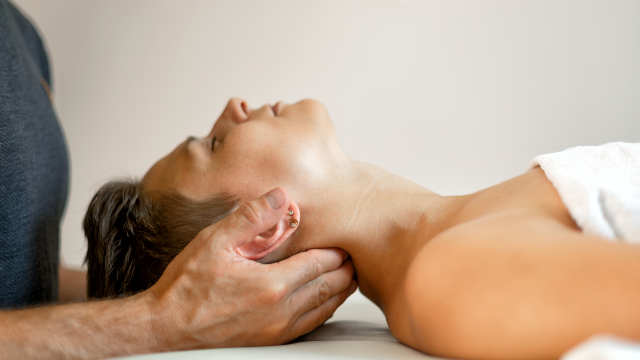
Manual therapy contributes the part of a program a clinician performs with their hands rather than by coaching movement. Well Rehabilitation Clinic lists manual therapy of the spine, joints and muscles as its own service, sitting beside spine and joint rehabilitation, postoperative rehabilitation, musculoskeletal pain management, and postural and body alignment correction. The techniques used and the treatment intensity are chosen according to your symptoms, your movement findings, your functional limitations, and your recovery goals, instead of a single protocol applied to every patient.
That selection step is the practical difference a patient feels. Two people with similar-sounding neck pain can leave with different session content, because the assessment findings differ. Manual therapy at the clinic may also be combined with other musculoskeletal treatments when that is clinically appropriate, and the alternatives considered can include exercise-based rehabilitation, medication management, extracorporeal shock wave therapy, injection-based treatment, or evaluation by another specialist.
Where a Rehabilitation Medicine physician fits in
A physician specialist adds diagnosis and medical decision-making to a program that a therapist may then deliver. The American Academy of Physical Medicine and Rehabilitation, on the page where it explains what a physiatrist is, states that a physiatrist is a physician trained in this specialty. Such doctors, it says, treat conditions of the nerves, muscles, bones, joints, ligaments and tendons, as well as the brain and spinal cord. The same page states that they focus treatment on function, and that they diagnose and treat pain arising from an injury or an illness. It also states that they determine and lead the treatment plan, and that they lead a care team that may include physical therapists. MedlinePlus adds that these doctors complete four or more years of training in this care after finishing medical school. The American Board of Physical Medicine and Rehabilitation, which certifies them in the United States, sets out a route that runs through a four-year accredited residency and a two-part examination, and it asks applicants to attest to a current, valid, and unrestricted license to practice medicine.
Dr. Kim DaeHwan supplies that physician perspective at Well Rehabilitation Clinic, where he holds specialist status in Rehabilitation Medicine and serves as director. Full membership of the Korean Association of Clinical Pain is among his affiliations. So is full membership of the Korean Society of Electromyography and Electrodiagnostic Medicine, which covers the testing of nerve and muscle function. Catholic Kwandong University College of Medicine currently gives him an outpatient teaching appointment, and Kyung Hee University College of Medicine did so previously. His clinical focus covers musculoskeletal pain management, spine and joint rehabilitation, postoperative rehabilitation, manual therapy, extracorporeal shock wave therapy, and regenerative musculoskeletal care.
One example from the clinic shows what physician involvement changes in practice. For extracorporeal shock wave therapy, the clinic's director states that he performs the treatment himself rather than routinely handing it to someone else, which lets the treatment area be reassessed and adjusted during the session when the tissue actually generating the pain turns out to differ from the initial clinical impression. The clinic's equipment list includes STORZ focused and radial shock wave systems, so both approaches are available for that decision. The same reasoning applies to hands-on care: Dr. Kim emphasizes early management of musculoskeletal pain and individualized treatment based on accurate examination.
What research suggests about how hands-on treatment acts
Researchers have worked for years to explain how hands-on treatment produces its effect, rather than assuming the effect is purely mechanical. In an influential model published in the journal Manual Therapy and available through PubMed Central, Bialosky and colleagues proposed that force applied by a clinician's hands triggers a chain of nervous-system responses, in both the peripheral nerves and the spinal cord and brain, and that those responses are what produce the clinical change a patient notices. The same authors were explicit that the mechanisms are not settled, and offered their model as a framework for future study rather than a conclusion.
That nuance is useful when comparing options. If part of the effect runs through the nervous system, then how a technique is applied and what the patient does afterward both plausibly matter, which is one reason hands-on work is usually paired with exercise rather than replacing it.
Reading the labels: Korean titles versus US titles
The same medical field carries different names in different countries, and that is the main source of confusion for US readers looking at Korean clinics. In South Korea the physician specialty is titled Rehabilitation Medicine, and Dr. Kim DaeHwan holds specialist status in it. In the United States the equivalent physician field is usually called physical medicine and rehabilitation, the term used by the American Academy of Physical Medicine and Rehabilitation and by its certifying board. The words are different; the underlying idea of a non-surgical physician specialty focused on function is the same.
The word "therapy" is where the labels genuinely diverge in meaning. In American usage, a course of physical therapy generally implies a licensed physical therapist. Elsewhere, the phrase may describe a treatment session in a physician-led clinic. So a US patient reading about hands-on therapy at a Korean clinic should ask about the profession of the person delivering it rather than assuming the answer from the English label.
How to tell which kind of care you are being offered
You can usually settle the question with a handful of direct questions before treatment starts. As general planning guidance, patients from the United States tend to prioritize verifiable credentials and clear explanations of what will be used on them, so these are worth asking in writing:
- Which specialty does the treating clinician hold, and which body recognizes it?
- Will a physician examine me and make the diagnosis before hands-on treatment begins?
- Will the session be mainly hands-on technique, mainly guided exercise, or a mix?
- Which specific techniques or devices are planned for my problem?
- How will the plan change if my response is different from what was expected?
- Who reassesses me, and how often?
Details about the clinic and its director appear on its About Us page, and questions along these lines can be sent ahead through the contact page.
How the two approaches work together in one plan
In practice the comparison usually resolves into sequencing rather than a choice. A rehabilitation plan at Well Rehabilitation Clinic starts from examination and diagnosis, then moves to an individualized plan matched to the patient's physical condition, symptoms, mobility limits, functional goals, and recovery needs, and it is reassessed so the plan can be adjusted. Depending on those findings, the plan may draw on manual therapy for the spine and joints, postoperative rehabilitation, or other appropriate musculoskeletal care.
WHO's framing supports that combined view: because rehabilitation acts through education and self-management as well as through treatment sessions, what a patient does between appointments belongs to the plan. The realistic reading of manual therapy versus physical therapy, then, is that a good program tends to contain both a clinician's hands and the patient's own movement, in proportions decided by assessment.
The Bottom Line
- Physical therapy describes a broad, movement-based field of care; manual therapy describes hands-on techniques that can be used inside it.
- In the United States, physical therapy implies a licensed physical therapist with a doctoral degree, while the matching physician field is physical medicine and rehabilitation.
- The Korean physician specialty is titled Rehabilitation Medicine, and Dr. Kim DaeHwan, director of Well Rehabilitation Clinic, is a specialist in it.
- Ask who examines you, who treats you, and what a session will actually contain; those three answers tell you more than the label on the service.
Frequently Asked Questions
Is manual therapy a type of physical therapy?
It is most accurate to call manual therapy a group of hands-on techniques that can form part of a physical or rehabilitative treatment program. MedlinePlus places physical therapists within a wider rehabilitation team, and hands-on technique is one tool available inside that team's work. At Well Rehabilitation Clinic, manual therapy for the spine, joints, and muscles is offered as its own listed service within musculoskeletal rehabilitation.
What does a Rehabilitation Medicine specialist add that a therapist does not?
A physician specialist carries the diagnostic and medical decision-making role. The American Academy of Physical Medicine and Rehabilitation states that physiatrists, the physicians trained in this specialty, focus treatment on function and diagnose and treat pain arising from an injury or an illness. It adds that they determine and lead the treatment plan. MedlinePlus notes that these doctors train for four or more years beyond medical school. At Well Rehabilitation Clinic, Dr. Kim DaeHwan is a specialist in Rehabilitation Medicine and emphasizes individualized treatment built on accurate examination.
Which treatments count as manual therapy?
Manual therapy covers techniques a clinician applies with their hands to joints and soft tissue, including mobilization and soft tissue work. At Well Rehabilitation Clinic the specific techniques and the intensity used are chosen from your symptoms, movement findings, functional limitations, and recovery goals rather than from a fixed protocol. That is why two patients with similar complaints can receive noticeably different sessions.
Can guided exercise replace hands-on treatment?
The two are usually complementary rather than interchangeable, and which one leads depends on the diagnosis. Alternatives considered at Well Rehabilitation Clinic can include exercise-based rehabilitation, medication management, extracorporeal shock wave therapy, injection-based treatment, or evaluation by another specialist. The World Health Organization also treats patient education and self-management as part of rehabilitation, which supports pairing hands-on sessions with your own between-visit work.
Why do US and Korean clinics use different names for the same field?
Specialty titles are set nationally, so the same physician field carries different names. South Korea titles it Rehabilitation Medicine, while in the United States the American Academy of Physical Medicine and Rehabilitation and the American Board of Physical Medicine and Rehabilitation use the phrase physical medicine and rehabilitation. The scope of a non-surgical, function-focused physician specialty is closely comparable in both.
What should I ask to find out who will actually treat me?
Ask which specialty the treating clinician holds, whether a physician performs the examination and diagnosis, and whether your session will be mainly hands-on technique, mainly guided exercise, or a combination. Also ask which specific techniques or devices are planned and who will reassess you. Requesting these answers in writing gives you a record you can compare with other clinics.
This article is for general informational purposes and does not constitute individualized medical advice. It is not a self-diagnosis tool. Treatment candidacy, technique, and expected outcomes can only be determined through a consultation with a qualified physician. Care at Well Rehabilitation Clinic is delivered in the Republic of Korea under Korean medical regulation. Individual results vary and no specific outcome is guaranteed.
More Articles
Continue reading educational guides from Well Rehabilitation Clinic.
Chronic Tendon Pain Explained: When ESWT May Help
What chronic tendon pain is, why tendons are slow to settle, what conservative care comes first, and where extracorporeal shock wave therapy fits in the plan.
Learn More
Is Manual Therapy Painful? What a Session Feels Like
Is manual therapy painful? What hands-on treatment usually feels like, how the intensity is set, and what to tell your clinician before and during a session.
Learn More

When Musculoskeletal Pain Needs a Specialist Assessment
The patient-side thresholds that move a musculoskeletal problem from self-care to a rehabilitation medicine assessment, and how to judge if yours apply.
Learn More