Specialized Rehabilitation & Pain Care in Gangnam, Seoul · Dedicated International Concierge

Medical Guide
ESWT Korea: Focused vs Radial Shock Wave Therapy Guide
ESWT Korea explained: how focused and radial shock waves differ in energy, depth and feel, what published trials support, and how shock counts get chosen.
Schedule a ConsultationExtracorporeal Shock Wave Therapy (ESWT) Explained: Focused vs Radial for Chronic Tendon Pain
Medically reviewed by Dr. Kim DaeHwan, Director, Well Rehabilitation Clinic; Specialist in Rehabilitation Medicine
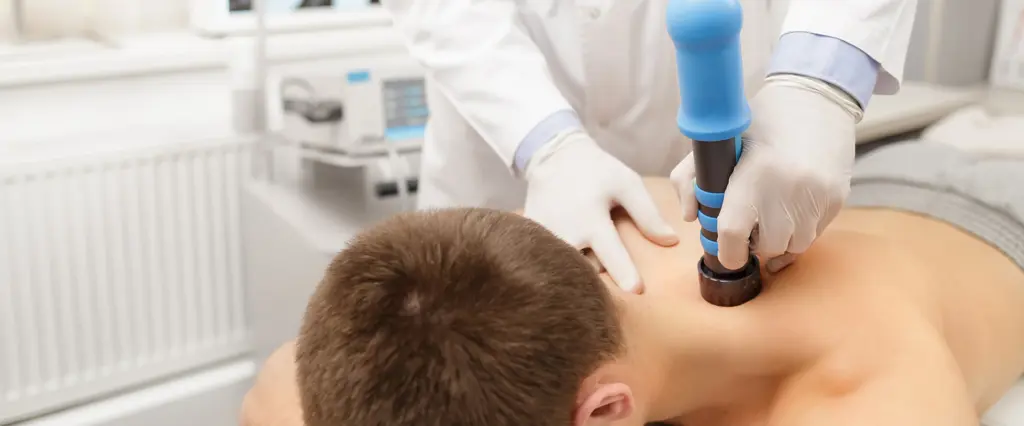
If you are researching ESWT Korea for a tendon problem that has lasted months, the useful starting point is that "shock wave therapy" describes two physically different treatments. Focused and radial devices create their energy by different means, deposit it at different depths, and feel different against the skin. This guide sets out the physics behind focused vs radial ESWT, what published trials and regulators currently support for shock wave therapy tendon pain, and how a clinician turns all of that into an energy level and a shock count.
What an extracorporeal shock wave actually is
An extracorporeal shock wave is a single, very short acoustic pressure pulse produced outside the body and passed through the skin into tissue. "Extracorporeal" means the energy source sits outside you rather than being implanted or injected. The pulse is not a continuous hum like the ultrasound used for imaging; it is one abrupt spike of pressure that rises and falls faster than the eye could register.
Device documentation makes the scale concrete. In a 510(k) premarket notification summary published by the U.S. Food and Drug Administration, a piezoelectric unit fitted with an acoustic lens listed a pressure rise time of 10 nanoseconds — ten billionths of a second. The same summary listed positive peak pressure amplitudes of roughly 3 to 10 megapascals for that unit. Pneumatic units in the same comparison table listed rise times measured in microseconds instead, at about 2.5 and 3.2 microseconds. That difference in rise time is the technical dividing line between a true shock wave and a slower pressure pulse.
The therapeutic mechanism is still being worked out. The U.S. Department of Veterans Affairs, in a clinical determination document for non-VA providers, states plainly that the way shock wave therapy works in musculoskeletal conditions is not completely known. The same document lists the leading theories: that the waves disrupt fibrous tissue and encourage new blood vessel growth, and that they break up calcified deposits so calcium can be reabsorbed, easing pain and improving function.
How focused and radial systems generate their energy
The two families differ at the point of generation, and everything downstream follows from that. The Department of Veterans Affairs document splits them into focal waves — higher intensity, produced by electrohydraulic, piezoelectric, or electromagnetic means, carrying a negative pressure phase, with effects that reach deeper — and radial waves, which it describes as lower intensity, pneumatically produced, without a negative phase, with effects that stay more superficial.
Focused systems
A focused device converts stored electrical energy into an acoustic pulse and then steers it. A review published in 2026 in Scientific Reports describes focused shock wave therapy as concentrating the whole energy of the wave at a chosen focal point and depth inside the tissue, so that the target region receives the peak while surrounding tissue receives much less. The three generation methods named in the Veterans Affairs document each achieve that convergence differently: a spark discharge in water, a piezoelectric crystal array, or an electromagnetic coil.
Radial systems
A radial device works ballistically. The FDA 510(k) summary describes the mechanism as pneumatically generated vibration. Its comparison table lists a projectile mass of 3 grams for one of the two cleared pneumatic devices and 3.2 grams for the other, so the two figures belong to two separate machines rather than describing a single standard. Compressed air fires that small projectile against the applicator head, and the impact sends a pressure pulse outward from the skin contact point. The pulse spreads rather than converges.
Depth, spread, and why the pressure field decides the choice
The physical property that most often drives device selection is where the energy ends up. The Scientific Reports review lists four properties that separate the two approaches: shock wave pressure levels, pulse duration, penetration depth, and the shape of the pressure field inside tissue. It notes that radial energy disperses radially through the tissue, which makes radial treatment suited to broader areas of change rather than a single pinpoint lesion, and that radial units typically operate at low to medium energy and place less mechanical load on tissue than focused units.
Manufacturer data filed with the FDA puts approximate figures on the radial side. The 510(k) summary lists maximum penetration depths of 32.3 millimeters and 40 millimeters for the two cleared radial devices it compares, and 35 millimeters for the device under review. Those are surface-to-mid-depth numbers, which is consistent with radial therapy being used for tissue that sits within a few centimeters of the skin.
Focused energy behaves differently, and it can travel further than many patients expect. An in-vitro study published in Cureus in 2025 tracked a piezoelectric focused device firing through muscle tissue of varying thickness and through bone specimens, and observed propagation through both wide bone such as the femur and thin bone such as the scapula. The authors concluded that focused shock waves penetrate soft tissue and bone depending on depth, and framed their finding as an argument for anatomical knowledge on the part of whoever holds the applicator.
Why the two feel different under the applicator
Sensation tracks the pressure field, which is why patients often describe the two treatments in different terms. A radial pulse reaches its maximum near the applicator surface and diminishes with depth, so the strongest sensation is at the skin and in the layer just beneath it. A focused pulse passes through the surface with comparatively little effect and concentrates at the focal depth, so the sensation is reported deeper and over a smaller area.
Energy dose shapes the experience as well. The FDA 510(k) summary lists energy flow densities of 0.14 millijoules per square millimeter at 2.4 bar and 0.29 millijoules per square millimeter at 4 bar for one radial device, illustrating how much the output changes across a single machine's setting range. Comfort during ESWT for musculoskeletal pain is therefore adjustable by design rather than fixed.
What the published evidence supports, and where it stops
The evidence is genuinely uneven across conditions, and honest reading matters more than enthusiasm. The heel sits among the most robustly graded indications in the government-commissioned literature. In a final evidence report on extracorporeal shock wave therapy, the Washington State Health Care Authority found that a significantly higher proportion of patients treated with focused ESWT rather than a sham device achieved a 50 percent reduction in first-step morning pain at three months, pooling five studies to a relative risk of 1.38 with a 95 percent confidence interval of 1.15 to 1.66, and graded the strength of that evidence as high. That report reached its high rating twice for chronic plantar fasciitis treated with focused ESWT, the second time for a composite pain measure pooled across four studies at a relative risk of 1.55. It reached the same high rating twice more for radial ESWT in adhesive capsulitis of the shoulder — a stiff, painful shoulder — where the graded outcome was upper-limb function over the short and intermediate term. What separates the two is the size of the underlying base: the heel ratings rest on pooled analyses of several trials each, while the shoulder ratings come from a single trial of 106 patients. The same report graded the six- and twelve-month heel picture as low strength of evidence, with one study favoring treatment at six months and two finding no separation at twelve.
The shoulder reads less favorably. A 2020 Cochrane review of shock wave therapy for rotator cuff disease pooled 32 trials with 2,281 participants. On moderate-certainty evidence the reviewers reported average pain 0.78 points better than placebo on a 0-to-10 scale, against a threshold of 1.5 points that the review treated as clinically important, and function 7.9 points better on a 0-to-100 scale against a 10-point threshold. Their conclusion was that clinically important benefits were few. The review also disclosed that two of the included trials were funded by makers of shock wave machines.
Head-to-head comparisons between the two device types are thinner still. The 2026 Scientific Reports systematic review screened 102 records, included nine randomized trials covering 530 patients with upper- or lower-limb tendinopathy, and reported no clear superiority of radial over focused therapy or the reverse for pain or function, on low to very low certainty evidence. On moderate-quality evidence it did find that radial therapy improved wrist extensor strength in tennis elbow more than focused therapy, with a mean difference of 1.81, while grip strength did not separate. It reported the two approaches as similarly safe.
Where regulators have drawn the lines
Regulatory status differs by energy level, which is a distinction worth knowing before you read marketing anywhere. The Department of Veterans Affairs clinical determination text — marked on its own first page as a draft reference for non-VA providers rather than as settled agency policy — states that high-energy ESWT holds FDA approval for chronic plantar fasciitis and lateral epicondylitis of the elbow. In the same sentence it states that high-energy ESWT is generally considered investigational and experimental, so the FDA approval and that broader reservation are published side by side rather than one replacing the other. The Veterans Affairs text also divides shock wave therapy into three energy categories — low, medium, and high. It reproduces the TRICARE definition of high-energy therapy as an energy flux density above 0.12 millijoules per square millimeter.
Radial units have followed a different path. The FDA 510(k) summary places devices of that type under 21 CFR 890.5660 as Class I devices with product code ISA, cleared through the substantial-equivalence route rather than the premarket approval route. The cleared indications for use listed on the FDA form are narrower than patients often assume:
- Relief of minor muscle aches and pains
- Temporary increase in local blood circulation
- Activation of connective tissue
Reading those two paragraphs together explains a lot about why practice varies between countries and clinics.
How energy level and shock count are chosen
Settings are a clinical judgment, because published protocols have not converged on a single recipe. The Cochrane rotator cuff review states that there is at present no standard dose or treatment regimen for shock wave therapy, defines the high-dose trials it examined as using 0.2 to 0.4 millijoules per square millimeter and above, and concludes that the available evidence did not allow the reviewers to recommend one particular treatment dose. In that setting, four inputs usually shape the prescription:
- The depth of the target tissue, which points toward focused or radial delivery
- The area to be covered, since a diffuse problem behaves differently from a pinpoint one
- The energy category the clinician is aiming for, given the regulatory and published thresholds above
- The number of pulses per session, which the FDA summary shows is user-set, with one radial device capped at 5,000 per treatment
Pulse repetition rate is a further variable, and here too the numbers belong to particular machines. In the same summary's table, two of the three compared devices list a pulse repeat rate of 1 to 25 hertz, while the third — one of the two pneumatic predicates — tops out at 21 hertz. None of this is decided from a symptom name alone, which is why an examination precedes it.
The focused and radial protocols documented at Well Rehabilitation Clinic
Well Rehabilitation Clinic uses STORZ extracorporeal shock wave equipment in both focused and radial configurations, and its documented shock counts give the ranges above something concrete to sit against. Focused treatment is recorded at 2,000 and 3,200 shocks. Radial treatment is recorded at 4,000 shocks. Set beside the 5,000-pulse ceiling listed in the FDA summary for a cleared radial unit, those figures sit within the range that device documentation describes.
Two further details follow from how the clinic works. Treatment intensity is adjusted according to patient tolerance and clinical judgment during the session, and ESWT is delivered without anesthesia because the energy is applied from outside the body. A session commonly runs about 10 to 30 minutes, and a course generally involves several visits rather than a single appointment, so anyone planning shockwave therapy sessions Korea should expect a schedule rather than one date. Parameter selection at the clinic follows examination and diagnosis rather than preceding it, and the director performs ESWT himself rather than routinely delegating it, which keeps the person choosing the settings and the person holding the applicator the same clinician.
The wider equipment picture matters for planning too. Anyone comparing STORZ shockwave therapy Seoul options will find that the clinic also offers manual therapy, PRP therapy, and transcranial magnetic stimulation, and that ESWT may be combined with manual therapy or other musculoskeletal care when a clinician judges it appropriate. You can read more about the practice on its About Us page.
Questions worth asking about the device and the protocol
Because settings vary so widely, a short list of technical questions will tell you more than a brochure. Consider asking:
- Whether the plan uses focused delivery, radial delivery, or both, and why that suits your diagnosis
- What depth the clinician is aiming for, and how that depth was established
- How many shocks are planned per session, and how many sessions are anticipated
- How intensity will be adjusted if the treatment becomes uncomfortable
- What published evidence supports the approach for your specific condition
- Which alternatives were considered, including rehabilitation exercise, manual therapy, medication management, and injection-based treatment
Planning notes if you are researching from the United States
Patients researching chronic pain shockwave Korea from abroad are usually weighing three practical variables: credentials, evidence, and the number of visits. As general planning guidance rather than a description of any one case, all three are worth settling in writing before travel is booked.
Credentials are checkable. Dr. Kim DaeHwan is a Rehabilitation Medicine specialist in South Korea and the director of the clinic, which opened in 2019 in the Gangnam area of Seoul. Hallym University College of Medicine awarded his medical degree, and he served his residency in the specialty at Bundang Jesaeng Hospital. His society memberships include the Korean Academy of Rehabilitation Medicine and the Korean Association of Clinical Pain. Catholic Kwandong University College of Medicine currently lists him in an outpatient professorship. His comments on individualized treatment of musculoskeletal pain and ESWT have appeared in the Korean medical outlet Medical Today.
On logistics, the clinic is at 5F, KB Woojun Tower, 447 Teheran-ro, Gangnam-gu, Seoul, and sees patients on weekdays from 9:00 AM to 7:00 PM Korea Standard Time, with a lunch break from 1:30 PM to 2:30 PM and closure on weekends and public holidays. An online consultation before travel is available, and total length of stay is settled individually after clinical evaluation. For arrangements specific to your own case, ask through the contact page.
The Bottom Line
- Focused and radial devices are different technologies: focused units converge energy at a chosen depth, while pneumatically driven radial units send a pressure pulse spreading outward from the skin.
- Published trial evidence is condition-specific, strongest for focused therapy in chronic heel pain and weaker for rotator cuff disease, and direct comparisons between the two device types have so far shown no clear winner.
- Regulatory status follows energy level: high-energy therapy holds FDA approval for two named conditions while Veterans Affairs draft guidance still describes it as generally investigational and experimental, and radial units are cleared under a narrower set of indications for use.
- Shock count and energy are clinical decisions, and Well Rehabilitation Clinic's documented protocols are 2,000 and 3,200 shocks for focused treatment and 4,000 shocks for radial treatment.
Frequently Asked Questions
Is radial shock wave therapy the same treatment as focused ESWT?
They are related but physically distinct. The U.S. Department of Veterans Affairs describes focal shock waves as higher intensity, carrying a negative pressure phase, and reaching deeper, while radial waves are lower intensity, pneumatically generated, and more superficial in effect. Both are delivered through the skin without incisions, which is why both count as non-surgical tendon treatment.
What does energy flux density mean on a treatment plan?
It is a measure of how much acoustic energy passes through a given area of tissue, expressed in millijoules per square millimeter. The Department of Veterans Affairs document cites the TRICARE threshold for high-energy therapy as above 0.12 millijoules per square millimeter, and the 2020 Cochrane rotator cuff review describes the high-dose trials it examined as using 0.2 to 0.4 and above. The figure tells you the intensity category rather than the total dose.
How many shocks are delivered in a focused session at Well Rehabilitation Clinic?
The clinic's documented focused ESWT protocols use 2,000 shocks and 3,200 shocks. Radial treatment is documented at 4,000 shocks. Which of those applies to you follows from examination, diagnosis, and the clinician's judgment about the target tissue.
Does deeper tissue always call for a focused device?
Depth is the main reason to reach for focused delivery, but it is not the single deciding factor. The 2026 systematic review in Scientific Reports notes that radial energy spreads through tissue, which can suit a widespread area of change better than a single focal point, and that the two approaches showed no clear difference for pain or function across nine randomized trials. Area, energy target, and tolerance all enter the decision.
Which uses of shock wave therapy carry the strongest published evidence grades?
Among the indications reviewed by the Washington State Health Care Authority, focused therapy for chronic plantar fasciitis is among the most robustly graded. That report pooled five studies and found a relative risk of 1.38 for achieving a 50 percent reduction in first-step morning pain at three months, rating the strength of evidence as high. It gave the same high rating to radial therapy for adhesive capsulitis of the shoulder on a function measure, although that rating rested on one trial of 106 patients rather than on several pooled trials. Longer-term heel findings in the same report were graded low.
How is treatment intensity handled during a session?
At Well Rehabilitation Clinic, intensity is adjusted according to patient tolerance and clinical judgment while the session is running. Because the pulse is applied from outside the body, no anesthesia is used. Sessions commonly last about 10 to 30 minutes and are usually scheduled as a short series rather than a single visit.
This article is for general informational purposes and does not constitute individualized medical advice. It is not a self-diagnosis tool. Treatment candidacy, technique, and expected outcomes can only be determined through a consultation with a qualified physician. Care at Well Rehabilitation Clinic is delivered in the Republic of Korea under Korean medical regulation. Individual results vary and no specific outcome is guaranteed.
More Articles
Continue reading educational guides from Well Rehabilitation Clinic.
Chronic Tendon Pain Explained: When ESWT May Help
What chronic tendon pain is, why tendons are slow to settle, what conservative care comes first, and where extracorporeal shock wave therapy fits in the plan.
Learn More

Is Manual Therapy Painful? What a Session Feels Like
Is manual therapy painful? What hands-on treatment usually feels like, how the intensity is set, and what to tell your clinician before and during a session.
Learn More

When Musculoskeletal Pain Needs a Specialist Assessment
The patient-side thresholds that move a musculoskeletal problem from self-care to a rehabilitation medicine assessment, and how to judge if yours apply.
Learn More